Play Burger Time (Midway) Retro Game Online
Core Gameplay Mechanics and Difficulty
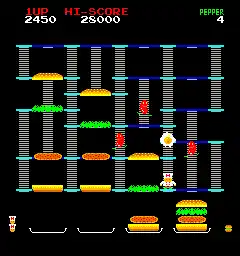
Burger Time is a classic arcade game that uniquely blends platforming and puzzle-solving elements. Players control Chef Peter Pepper as he navigates multi-layered burger structures, avoiding various food-themed enemies. The primary objective is to assemble hamburgers by walking over the ingredients, which drop down when traversed. This simple mechanic adds complexity, as timing and precision are crucial to avoid enemy encounters. The challenge escalates with each level, where faster enemies and tighter spaces test players' reflexes and strategic thinking.
The gameplay encourages a mix of urgency and careful planning. With limited lives and increasing difficulty, players often experience a delightful blend of frustration and satisfaction. The game's straightforward controls make it accessible, yet the depth of strategy required keeps seasoned gamers engaged. The repetitive nature of ingredient collection can lead to addictive gameplay, as players strive to beat their previous scores in a race against the relentless marching foods.
Historical Release Background and Innovations
Launched in 1982 by Midway, Burger Time emerged as a significant title in the early arcade gaming landscape. Initially developed as a way to capitalize on the growing interest in food-themed games, its release coincided with a boom in arcade culture. The game featured an innovative design by designer and programmer, Goichi Suda, who used clever design cues to engage players. Unlike many contemporaries, Burger Time's success relied not solely on high-octane action but also on cerebral gameplay.
Technologically, the game showcased vibrant graphics and catchy sound effects that were cutting-edge for its time. It encouraged interactions with its environment, a novel idea that paved the way for future platformers. The introduction of unique enemy behaviors and responsive gameplay became templates for subsequent games, influencing genres beyond the arcade. Burger Time not only captured the hearts of players but also showcased the potential of arcade games to create lasting experiences.
Cultural Impact and Legacy
Even decades after its release, Burger Time retains a place in gaming nostalgia. Its charm inspired multiple sequels, merchandise, and even adaptations into later gaming consoles, illustrating its cultural impact. The game's quirky premise resonates with audiences, making it a staple in retro gaming discussions. Its influence can be seen in modern titles that adopt similar mechanics, reinforcing the notion that gameplay innovation is often timeless.
In conclusion, the legacy of Burger Time transcends its simplicity. It combined engaging gameplay with a unique theme, leaving a lasting mark on the gaming industry. Today, players remember it not just as an arcade game but as a charming slice of gaming history that continues to inspire. Through its mix of strategic depth and nostalgic allure, Burger Time remains a cherished gem in the annals of video game evolution.
![The King of Fighters 2002 Magic Plus II (bootleg) [Bootleg]](https://playretrogames.org/uploads/images/the-king-of-fighters-2002-magic-plus-ii-bootleg-bootleg.webp)
![The King of Fighters 2002 Super (bootleg) [Bootleg]](https://playretrogames.org/uploads/images/the-king-of-fighters-2002-super-bootleg-bootleg.webp)
![Street Fighter II' - Champion Edition (YYC bootleg set 2, 920313 etc) [Bootleg]](https://playretrogames.org/uploads/images/street-fighter-ii-champion-edition-yyc-bootleg-set-2-920313-etc-bootleg.webp)